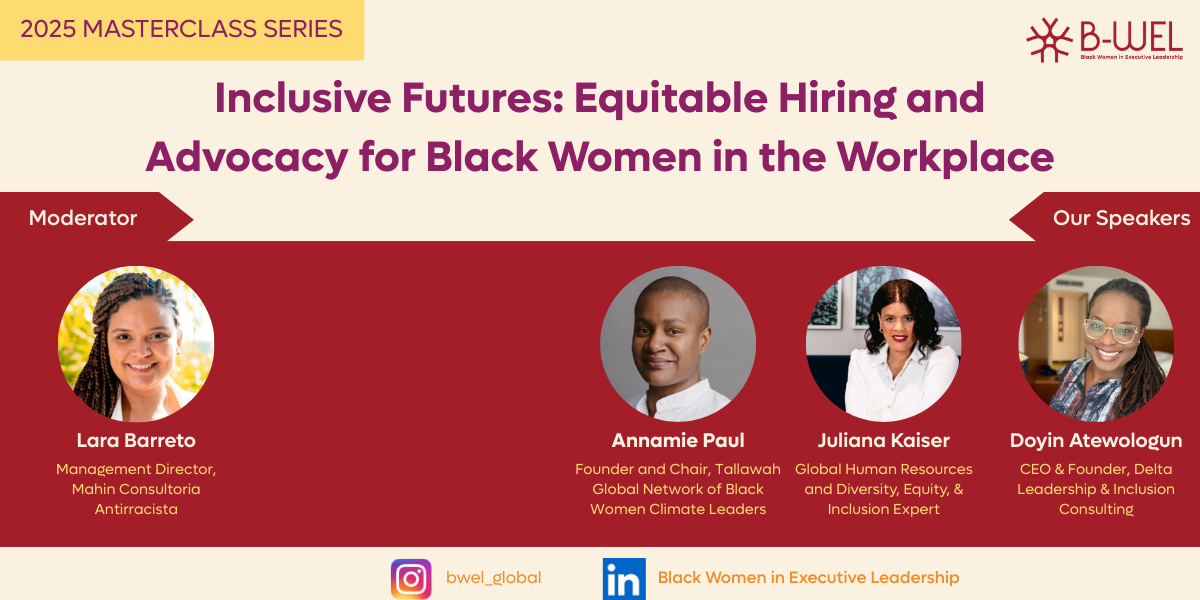
Inclusive Futures: Equitable Hiring and Advocacy for Black Women in the Workplace
Written By:
Deloise Jesus | Co-written by Jessica Kihori
December 11, 2025
This blog post was inspired by key Takeaways from ‘Inclusive Futures: Equitable Hiring and Advocacy for Black Women in the Workplace’ Masterclass featuring Annamie Paul, Doyin Atewologun and Juliana Kaiser. Moderated by Lara Barreto.
1. Inclusion begins long before the hiring stage
A truly inclusive hiring process is only possible when an organization makes a strategic, values-driven commitment to equity. Without this foundation, diversity efforts become fragile and performative rather than transformative.
2. Inclusive Hiring Requires Intentional and Thoughtful Design
An equitable recruitment journey requires transparency, clarity, and preparation. Organizations must ensure:
These intentional practices level the playing field and affirm candidates’ dignity.
3. Representation on interview panels matters
Panels that reflect diversity in race, gender, and lived experiences build trust, reduce bias, and signal that the organization values the presence and leadership of Black women.
4. Fair evaluation requires contextual understanding
Black women are often technically qualified but not chosen because their career paths are judged through inequitable lenses. A just assessment acknowledges systemic barriers, socioeconomic context, and the resilience required to advance despite them.
5. Inclusion is not the responsibility of Black women
Too often, organizations position the challenges Black women face as issues they must solve alone or reduce them to “career development gaps.” The problem is not the women, it is the systems and structures that were not built for them.
6. Leadership holds the accountability
Equity cannot be outsourced. Leaders must take responsibility for creating environments where all employees, including Black women, feel belonging, safety, and support. When leadership commits, the entire organization thrives.
7. Black women’s leadership is an asset, not an exception
Their presence should not be treated as symbolic or burdensome. Black women bring critical insights, innovation, and excellence that elevate organizational performance and culture.
8. Promises of Inclusion That Faded Under Pressure
Many organizations rushed to hire Black women into leadership roles after George Floyd’s murder. Without structural readiness or genuine commitment, these women were unsupported and pushed out causing harm and reinforcing mistrust. Today, many organizations are retreating from hiring Black women, despite having better knowledge and tools for inclusion. This avoidance signals not a lack of solutions, but a lack of will.


